Designing a Mobile Application for Women's Health Tracking
Exploring how a mobile tool can help young adult women make sense of symptoms and connect lived experiences with credible medical research.
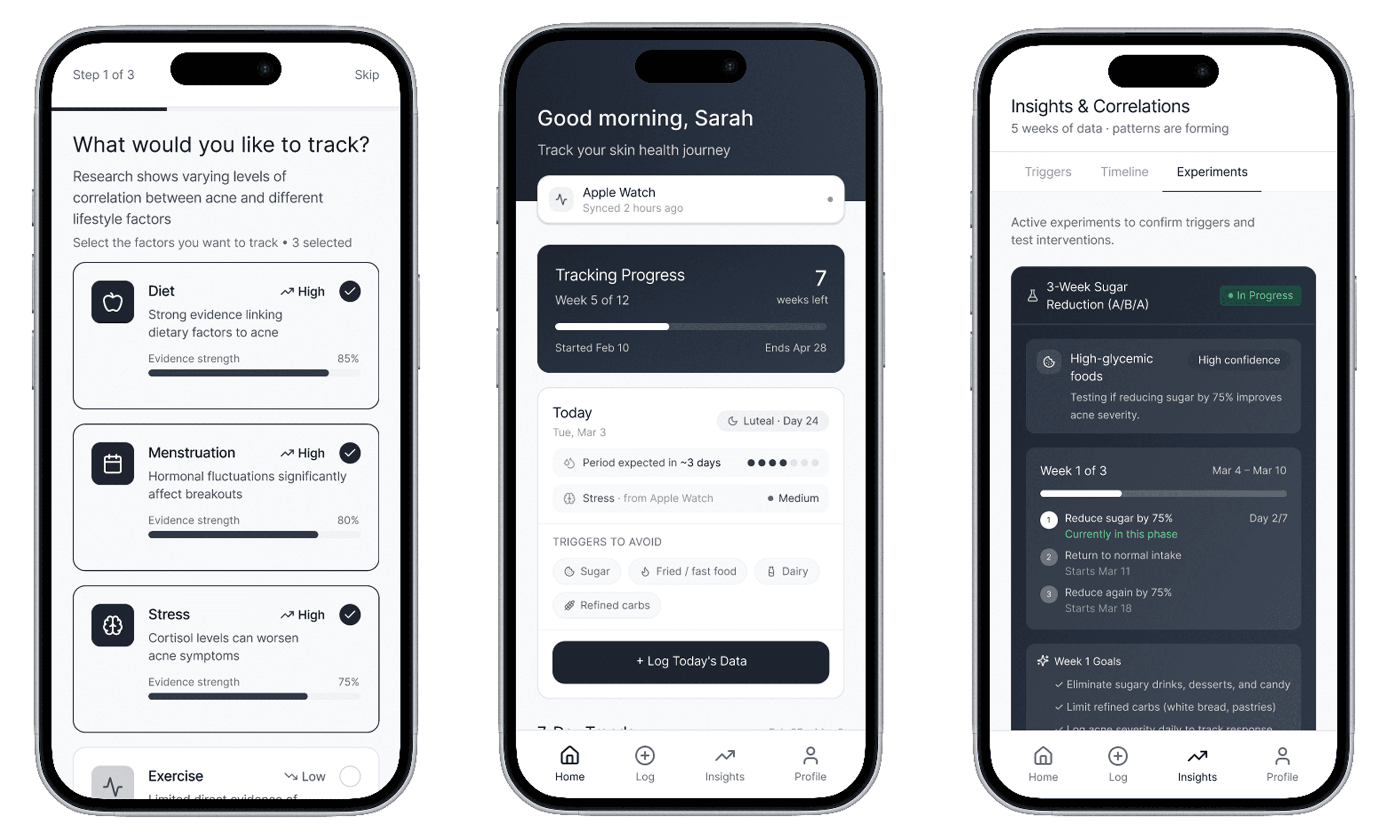
Overview
This project explores how a mobile tool can help young adult women make sense of recurring bodily symptoms by connecting lived experience with credible medical research. I used acne as the initial symptom focus because it offered enough available literature to support design decisions around tracking, time scales, and self-experimentation, while also revealing a broader opportunity: many women’s symptoms are discussed online in fragmented, anecdotal, and often unreliable ways. Rather than framing this as only an acne app, I approached it as a system for helping users interpret symptoms over time, identify patterns, and bridge personal experience with credible health information.
The problem
Young adult women often turn to social media, forums, and online communities to understand bodily changes, but the information they find is fragmented, inconsistent, and difficult to trust. At the same time, vetted medical resources provide credible information without personal context, making it hard to translate general guidance into insight about one’s own body.
This creates a gap between lived experience and medical knowledge, anecdotal information and credible research, and symptom logging and actual sensemaking. The opportunity was to design a product that helps users understand what their symptoms might mean, what factors may be related, and when they have learned enough to stop tracking.
Research context
Early discovery work surfaced a broad set of women’s health topics being discussed online, including period changes, PCOS, “second puberty,” hormonal shifts in the 20s and 30s, cramps, and acne. These conversations revealed a clear need for a tool that could help users make sense of bodily changes without forcing them to self-diagnose or rely entirely on social media.
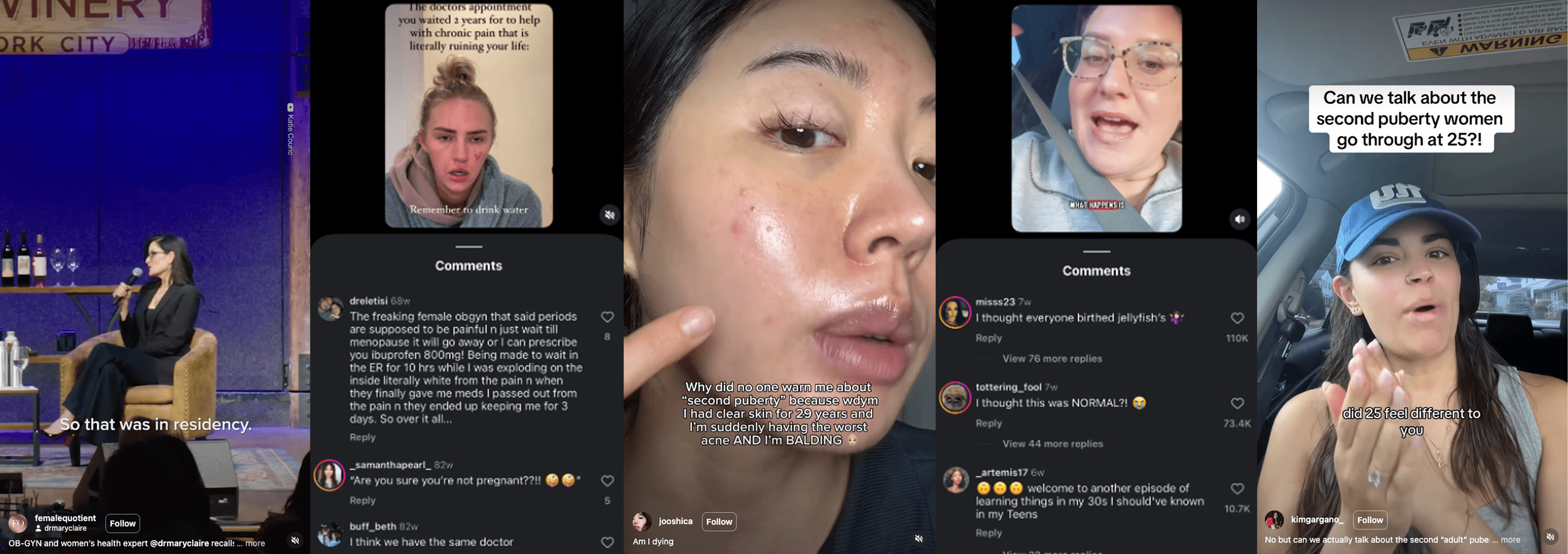
From this wider space, I narrowed the project to acne as the initial symptom focus. Acne was a strong starting point because it is common, emotionally visible, and supported by enough research to inform design decisions. It also lends itself well to lightweight tracking and time-based pattern recognition, making it a practical entry point for a broader symptom-sensemaking system.
Scope and audience
The target audience for this concept is young adult women, roughly late teens to 30s, who are already trying to understand recurring symptoms and want clearer, more trustworthy guidance. This audience is broad enough to include many common symptom experiences, but focused enough to avoid designing for every possible health condition at once.
Acne was selected as the first symptom to design around because the research base was strong enough to justify product decisions. Other symptoms could later be supported by the same system, but acne served as a research-backed starting point.

Discovery and inspiration
Online sensemaking
In early discovery, I reviewed content from Instagram, Reddit, PatientsLikeMe, Mayo Clinic Connect, and similar communities to understand how women talk about their symptoms.
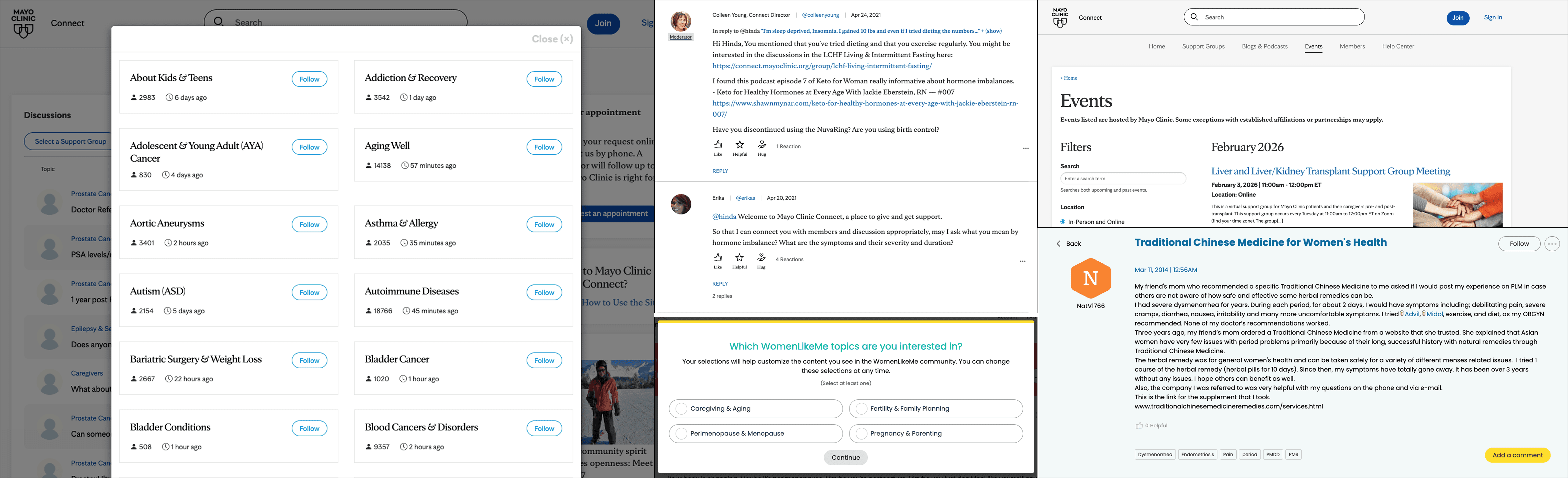
A few patterns stood out:
women already do a lot of self-interpretation online,
community spaces can help users feel less alone,
but those spaces are unevenly moderated and often unreliable,
and users still struggle to separate personal stories from medically supported explanations.
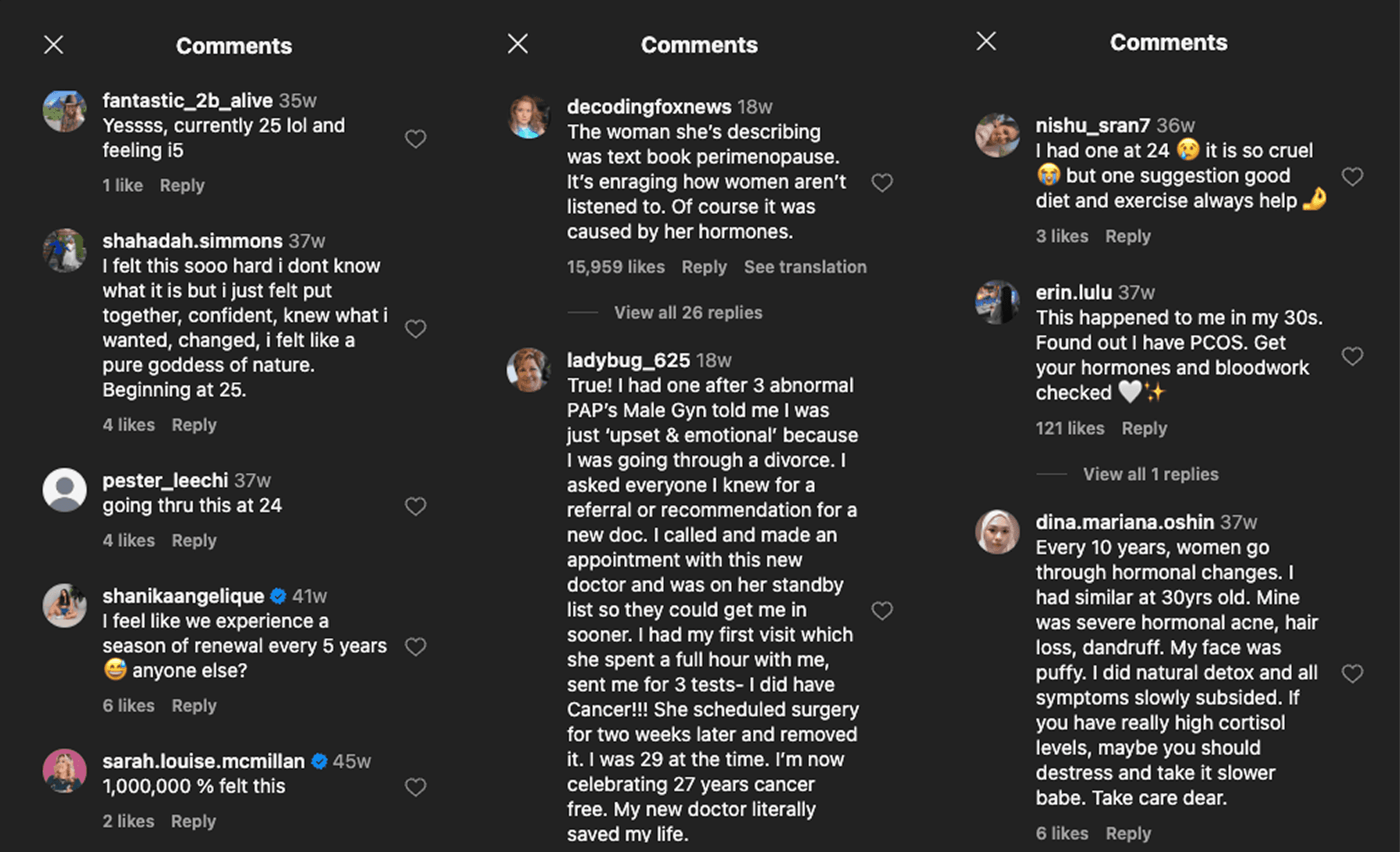
These online conversations functioned like a complement to formal interviews or surveys, giving me a sense of how women talk about symptoms, what they seek, and what they find confusing. Looking at user conversations online helped ground the problem in lived experience.
Together, the medical literature and the social‑media patterns show that many women are dealing with symptoms all the time, and the real challenge is knowing how to make sense of all that information. Research and online advice often reflect population-level patterns, but they do not always show how those patterns apply to an individual. This reinforced the need for a product that helps users move from fragmented stories to structured, individualized understanding of which factors are actually relevant to their own bodies.
Existing product patterns
I also looked at condition pages, symptom trackers, and self-monitoring tools.
These informed several strategic decisions:
keep daily logging lightweight,
make the product useful over a finite period,
surface trends instead of raw logs,
and guide users toward a clearer understanding of what is and is not relevant for their body.
Evidence review: what informed the product
For many common symptoms, there are multiple possible contributing factors, and the main challenge is helping each person understand which ones are actually driving their own experience. This section reviews the evidence that informed which factors were prioritized in the product and how the experience was designed to support more personalized interpretation. Below, I map the factors I focused on to the symptom of acne for this case study.
😖
Stress & acne
Higher perceived stress has been associated with greater acne severity in observational studies.
This supports tracking stress as one of the core factors.
It also justifies showing weekly stress–acne trends rather than treating stress as background noise.
🍕
Diet & acne
High-glycemic diets are associated with worse acne outcomes.
Certain dairy exposures, especially milk, appear repeatedly in acne literature.
Diet was therefore included as a primary tracking factor, with emphasis on sugary foods, fried foods, and dairy.
🩸
Menstrual cycle & acne
Many women experience acne flares in the late luteal phase or before menstruation.
This supports cycle-aware tracking and calendar-based insights.
It also suggests that timing matters as much as the symptom itself.
🧪
Self-experimentation
Prior work on structured self-experimentation shows that people can learn a great deal from simple, guided on/off experiments.
This influenced the idea of a product that helps users test whether a factor seems personally relevant rather than asking them to track everything indefinitely.
Design goals & principles
🤳🏻
Meaningful tracking with minimal burden
The product should capture enough information to reveal patterns without overwhelming the user. Instead of asking for everything, it should focus on the variables most likely to matter: symptom severity, diet exposure, stress, and cycle phase.
⏱️
Design around time
The app should reflect the fact that symptom change does not happen instantly. Weekly summaries and 8–12 week trends are more useful than daily guesses, especially for diet-related patterns and hormonal fluctuations.
🗓️
Design for a finite tracking period
The app should support a defined learning period rather than create dependency. Once users have enough data to see patterns or understand their symptom better, the app should help them feel confident that they have learned enough to take action.
👩🏫
Design for interpretation, not just logging
The goal is not to collect more data forever. The product should help users understand what the data means, which factors may matter, and what patterns are worth paying attention to.
🩺
Design for extensibility
Acne is the first example, not the final product. The system should be able to support other symptoms later, especially those where women are already trying to make sense of bodily changes without enough reliable information.
Core product strategy
This project was approached less like a single-condition tracker and more like a system for helping users make sense of symptoms over time.
The main strategic decisions were to:
choose a symptom with enough research to support product design,
help users filter down on significant factors affecting the symptom,
use time-based insight rather than isolated daily logs,
frame the app as a learning tool with an endpoint,
and make the experience adaptable to other symptoms later.

This made the project more useful as a product concept because it focused on how to help a specific audience make better decisions, not just how to log symptoms.
Solution & key features
Onboarding
The onboarding flow should:
clarify that acne is the current symptom being tracked,
guide users toward the factors most likely to be relevant based on existing research,
help them test those likely triggers in the context of their own bodies,
explain that the app is for pattern recognition, not diagnosis,
and set expectations for a finite tracking window.
This helps users understand what the app is for, why they are tracking, and how long they need to stay engaged.
Home screen
The home screen should provide a fast daily entry point with:
a quick symptom check-in,
a short log for chosen factors,
and a compact summary of recent trends.
The goal of this screen is to make daily logging feel simple while keeping the user connected to their broader progress.
Insights
The Insights section is designed to help users spot possible relationships between their symptoms and the factors they are tracking, such as diet, stress, or cycle timing. Rather than presenting data as a final answer, it highlights patterns and uncertainties so users can see where there may be a meaningful connection and where more evidence is needed. From there, the app guides users toward targeted self-experiments, giving them a structured way to test the factors that seem most likely to matter for their own bodies.
Experiments
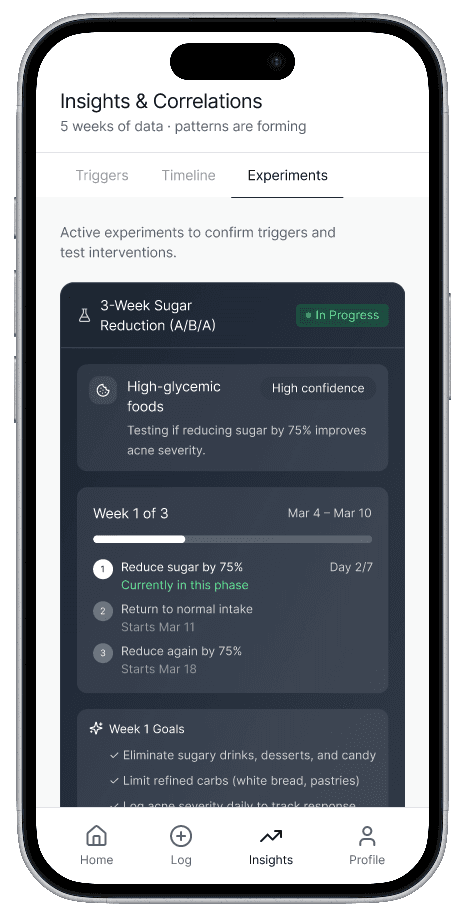
The app can support lightweight, guided self-experimentation so users can test specific questions, such as whether dairy or a high-sugar week seems to affect their symptoms.
Rather than leaving users to design experiments on their own, the system helps structure what to change, what to track, and how long to observe it so the results feel more meaningful and easier to interpret.
Over time, these experiments are meant to increase confidence in whether certain factors are actually influencing the chosen symptom, giving users enough evidence to take action off-app with more certainty.
This feature helps the product move from passive tracking into active sensemaking.
Off-ramp
A key part of the experience is helping users stop using the app when they no longer need it, rather than keeping them engaged forever. The app is designed as a temporary support system, a tool that helps users move from uncertainty to clarity and then to decisions they can take in their daily life. In this framing, success is measured by whether users feel ready to act, not by how long they stay in the app.
Users no longer need the app when they feel confident they understand what’s going on with their symptoms, usually after seeing patterns over time and testing specific triggers through self‑experiments. The goal is not just "I know what’s happening," but "I know what to do about it," and that is the core definition of success for the product. For example, this might mean adjusting diet, changing skincare routines, setting boundaries around stress, or preparing more targeted questions to ask a clinician. By helping users arrive at a point where they feel ready to act off‑app, the product reframes success as empowerment, and choosing to delete the app can feel like a natural, positive outcome of the experience.
Reflection
This project taught me how to translate research into product strategy. Instead of designing around a symptom in isolation, I had to think about:
who the product is for,
what kind of sensemaking they need,
which factors are worth tracking,
how long the product should be used,
and how to make the output actionable rather than overwhelming.
I also learned that a strong product project is not just about what screens were designed, but about the strategic decisions behind them. Acne was the initial lens, but the broader product opportunity is a tool that helps women make sense of symptoms, connect experience with evidence, and eventually stop needing the app altogether.
Next steps
Possible next steps include:
usability testing with young women who experience acne and general feedback on the actual prototype,
testing whether the finite tracking model feels motivating rather than restrictive,
exploring whether the same structure can support other symptoms later,
and refining the insights language so it feels clear, trustworthy, and non-judgmental.
References
Conforti, C., Di Meo, N., Dianzani, C., Giuffrida, R., Zalaudek, I., & Di Meo, N. (2021). Acne and diet: A review. Journal of the American Academy of Dermatology.
Karkar, R., Zia, J., Vilardaga, R., Scofield, J., Huang, Y., Kientz, J. A., & Fogarty, J. (2017). TummyTrials: A feasibility study of using self‑experimentation to detect individualized food triggers. In Proceedings of the 2017 CHI Conference on Human Factors in Computing Systems (pp. 6850–6863). Association for Computing Machinery.
Lucky, A. W., Biro, F. M., Huster, G. A., Elder, N., Morrison, J. A., & Crawford, P. (2001). The effect of the menstrual cycle on acne. Archives of Dermatology, 137(5), 668–672.
Yosipovitch, G., Tang, M., Dawn, A. G., Chen, M., Goh, C. L., Huak, Y., & Chan, Y. H. (2007). Study of psychological stress, sebum production and acne vulgaris in adolescents. Acta Dermato‑Venereologica, 87(2), 135–139.
Additional literature reviewed
Beyond the sources cited above, I also reviewed the following papers to inform my understanding of online sense-making and gaps in women's health, as well as acne’s relationship with treatment time scales, diet patterns, specific dietary components:
Fry, M. (2025). Women are woefully under-researched—the Message project aims to redress the balance. BMJ, 388, r581. https://doi.org/10.1136/bmj.r581
John, J. N., Gorman, S., Scales, D., et al. (2025). Online misleading information about women’s reproductive health: A narrative review. Journal of General Internal Medicine, 40, 1123–1131. https://doi.org/10.1007/s11606-024-09118-6
Juhl, C. R., Bergholdt, H. K. M., Miller, I. M., Jemec, G. B. E., Kanters, J. K., Ellervik, C., & Afzal, S. (2020). Dairy intake and acne vulgaris: A Mendelian randomization study and a review of the literature. JAMA Dermatology, 156(8), 854–861.
Layton, A. M., Eady, E. A., Whitehouse, H., Del Rosso, J. Q., Thiboutot, D., & El‑Azawi, S. (2023). Effectiveness of spironolactone for women with acne vulgaris (SAFA): A randomized, double‑blind, placebo‑controlled trial. The BMJ, 381, e073arden.
Malki, L. M., Patel, D., & Singh, A. (2023). A mixed-methods analysis of women’s health misinformation on social media. In J. N. Abdelnour Nocera, M. Kristín Lárusdóttir, H. Petrie, A. Piccinno, & M. Winckler (Eds.), Human-computer interaction – INTERACT 2023 (Vol. 14144, pp. [page range if needed]). Springer. https://doi.org/10.1007/978-3-031-42286-7_22
Melnik, B. C. (2012). Diet in acne: Further evidence for the role of nutrient signalling in acne pathogenesis. Acta Dermato‑Venereologica, 92(3), 228–231.
Park, J. E., Choe, S.-A., Kim, S., & Min, H. S. (2025). Exploring factors affecting knowledge creation in under-researched healthcare topics: A case study of women’s health research. Health Research Policy and Systems, 23(1), Article 62. https://doi.org/10.1186/s12961-025-01339-3
Smith, R. N., Mann, N. J., Braue, A., Mäkeläinen, H., & Varigos, G. A. (2007). A low‑glycemic‑load diet improves symptoms in acne vulgaris patients: A randomized controlled trial. American Journal of Clinical Nutrition, 86(1), 107–115.
Silverberg, N. B. (2012). Whey protein supplementation and its association with acne vulgaris: A preliminary report. Cutis, 90(5), 241–247.
Faculty advisor
I would like to recognize Dr. Pedja Klasnja, Professor of Information at the University of Michigan School of Information, for his guidance and advisement throughout this project.